If you regularly work with plywood, hardwood, countertops, trim, cabinets, or other sheet materials, having one of the best jigsaw tools for projects can make a surprisingly big difference. A jigsaw is not usually the first power saw people think about when they hear “heavy duty,” but that does not mean it is a lightweight tool. The right model can handle demanding cuts while giving you something a circular saw simply cannot provide: excellent control over curves, openings, notches, and intricate shapes.
The market in 2026 offers plenty of choices, from inexpensive cordless models to professional machines designed for daily jobsite use. Current comparisons commonly highlight models from DEWALT, Bosch, Milwaukee, Makita, and Ryobi, with brushless cordless models becoming especially popular for contractors and serious DIY users.
What Makes a Jigsaw Heavy Duty?
A heavy-duty jigsaw is more than a tool with a powerful motor. For demanding projects, you want a combination of motor performance, blade stability, durable construction, low vibration, useful speed control, and a solid base plate. These characteristics determine whether the saw follows your cutting line smoothly or fights you throughout the job.
A good example is the Bosch JS470E. It uses a 7-amp motor, variable-speed control, constant response circuitry, a die-cast aluminum footplate, four orbital-action settings, and a tool-free T-shank blade system. Bosch also lists cutting capacities of up to 5-7/8 inches in softwood, although the actual result depends heavily on the blade and material.
Motor Power and Cutting Performance
Motor power becomes especially important when you move from thin plywood to thicker lumber or hardwood. A weak saw may still cut, but you will have to slow down considerably and allow the blade to work rather than forcing it through the material.
For professional users, a brushless cordless motor is particularly attractive because it can provide strong performance without the maintenance associated with traditional brushed motors. The DEWALT DCS334 series, for example, uses a brushless motor and four-position orbital action, while its kit version includes a 20V MAX 5Ah battery and charger.
Why Jigsaw Tools Are So Useful for Projects
The biggest advantage of a jigsaw is versatility. Think of a circular saw as a tool designed to travel confidently in a straight highway lane; a jigsaw is more like a vehicle that can navigate winding country roads. You can use it to cut curves, openings, arches, notches, and shapes that would be difficult or impossible with many other saws.
This makes jigsaw tools for projects particularly useful for cabinet installation, countertop openings, furniture construction, flooring work, craft projects, remodeling, and general carpentry. A jigsaw can also make plunge cuts when you use the correct technique and blade.
Curved Cuts and Intricate Designs
Curves are where the jigsaw really earns its place in a workshop. Whether you are shaping a wooden tabletop, cutting a decorative pattern, creating a sink opening, or trimming a piece of plywood, the narrow blade allows considerably more maneuverability than a circular saw.
The trick is not simply having the fastest saw. Precision depends on controlling the tool and selecting an appropriate blade. Too much speed, aggressive orbital action, or pushing the saw too quickly can produce rough edges and cause the blade to wander.
Best Jigsaw Features to Look For
When shopping for the best jigsaw tools for projects, look beyond the marketing claims. Pay attention to stroke speed, orbital settings, blade-changing systems, bevel adjustment, vibration control, shoe construction, visibility around the blade, and whether the tool fits your existing battery platform.
Current 2026 comparisons show that many leading jigsaws offer approximately 3,000 to 3,500 strokes per minute at maximum speed, with several professional cordless models using brushless motors and tool-free blade changes.
Variable Speed and Orbital Action
Variable speed provides you greater control. Lower speeds can be useful when working carefully around delicate materials, while higher speeds can help when cutting suitable wood quickly.
Orbital action changes the movement of the blade so that it travels slightly forward as it moves through its stroke. This can increase cutting speed, although maximum orbital action is not always the best choice for a clean finish. For detailed work, you will often want a gentler setting.
Blade Changes and Bevel Adjustment
Tool-free blade changes are another feature worth paying for, particularly if your projects involve different materials. Stopping to find a wrench every time you need to change a blade becomes frustrating surprisingly quickly.
Bevel adjustment is equally useful when making angled cuts. Many current models provide adjustment up to approximately 45 degrees, although the exact mechanism and available stops differ between tools.
Corded vs Cordless Jigsaw Tools
Choosing between corded and cordless is largely about how and where you work. A corded jigsaw can make an excellent workshop tool because you do not have to monitor battery charge, while a cordless model is much easier to carry around a construction site.
When Corded Makes More Sense
For a fixed workshop, a corded jigsaw can still be an excellent choice. The Bosch JS470E, for instance, provides a 7-amp motor and a 500–3,100 SPM variable-speed range, along with a durable aluminum gearbox and large die-cast footplate.
When Cordless Is the Better Choice
Cordless tools become particularly attractive when you already own batteries from a compatible platform. Instead of buying another charger and battery system, you can purchase the bare tool and use batteries already in your workshop.
The DEWALT DCS334B, Milwaukee M18 models, and Makita LXT jigsaws are examples of cordless options currently competing in the professional market.
Best Heavy-Duty Jigsaw Tools for Projects
There is no single jigsaw that is perfect for everyone. The best choice depends on your material, workload, budget, and existing tools.
DEWALT 20V MAX XR
The DEWALT DCS334B is one of the strongest all-around choices for people already invested in the 20V MAX platform. Current manufacturer information highlights its brushless motor, four-position orbital action, and all-metal lever-action keyless blade clamp.
It is especially appealing for contractors who need portability without sacrificing useful cutting performance. Its cordless design also makes it convenient for renovation work where access to electrical outlets may be limited.
Bosch JS470E
The Bosch JS470E remains a compelling corded option for workshop users and professionals who prioritize controlled cutting. Its 7-amp motor, variable-speed system, four orbital settings, low-vibration design, and die-cast aluminum footplate give it a strong specification sheet for demanding woodworking.
If you do not need cordless convenience, this is the kind of tool that can make sense as a dedicated workshop jigsaw.
Milwaukee M18 FUEL
Milwaukee’s M18 FUEL jigsaw range is another serious option for professionals already using the M18 battery ecosystem. Current 2026 comparisons place the Milwaukee among the higher-performance cordless choices, with reported maximum speeds around 3,500 SPM depending on the model.
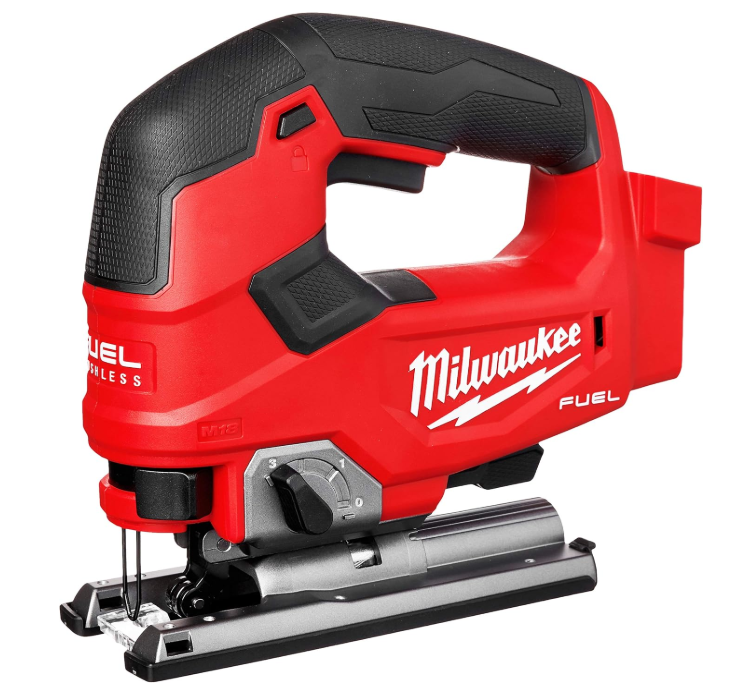
Its main attraction is not just speed. For professionals, the larger question is whether the tool delivers enough control and durability for repeated daily use.
Also check out Milwaukee’s M8 Fuel Impact driver
Choosing the Right Jigsaw for Your Project
Woodworking and Carpentry
For woodworking, prioritize blade control and clean cutting over raw speed. A jigsaw with variable speed, multiple orbital settings, a rigid base, and good visibility around the blade will usually be more useful than a model that simply advertises the highest SPM number.
If you frequently cut thick hardwood, look carefully at the manufacturer’s published cutting capacity and pair the saw with a quality blade designed for that material.
Renovation and DIY Projects
For homeowners and DIY users, versatility may matter more than maximum capacity. A cordless jigsaw can be particularly convenient for installing flooring, modifying cabinets, cutting plywood, making openings, and completing occasional repair projects.
If you already own batteries from DEWALT, Milwaukee, Makita, Bosch, or Ryobi, staying within that ecosystem can also reduce the total cost of ownership.
Jigsaw Blades Matter More Than You Think
Even an expensive heavy-duty jigsaw cannot compensate for the wrong blade. Blade selection should match the material and the finish you want. Fine-tooth blades are generally better suited to cleaner cuts, while aggressive blades can remove material faster.
Keep several blade types available rather than expecting one blade to handle every job. When a blade becomes dull, replace it instead of forcing the tool through the material. A dull blade creates heat, slows cutting, increases vibration, and can make even a premium jigsaw feel underpowered.
How to Get Cleaner, Safer Cuts
Start by marking the cutting line clearly and supporting the workpiece properly. Allow the saw’s base to remain flat against the material, maintain a controlled feed rate, and avoid twisting the tool to force the blade around a curve.
For delicate surfaces, consider using an appropriate fine-tooth blade and reducing orbital action. Keep your hands away from the blade path, wear suitable eye protection, and allow the blade to stop completely before setting the tool down.
Are Jigsaw Tools Sold on Amazon Worth Buying?
Jigsaw tools for projects sold on Amazon can be convenient because you can compare models, packages, reviews, and accessories in one place. However, price should not be your only consideration. A cheap bare tool may look like a bargain until you discover that the required battery and charger cost almost as much as the saw.
Before buying, check whether the listing includes a battery, charger, carrying case, blades, or only the bare tool. Also verify the exact model number because manufacturers frequently sell several packages that look almost identical.
Final Verdict
The best jigsaw tools for projects are not necessarily the most expensive ones. The right choice is the tool that gives you enough power for your materials, sufficient control for your cutting style, and a platform that makes sense for your existing equipment.
For a corded workshop machine, the Bosch JS470E stands out for its 7-amp motor, four orbital settings, variable speed, and sturdy construction. For cordless users, the DEWALT 20V MAX XR is a strong all-around option, while Milwaukee and Makita provide compelling alternatives for users already invested in those battery ecosystems.
Ultimately, buy for the work you actually do. A jigsaw with excellent blade control, the right blade, and sensible speed settings will often outperform a more powerful machine used with the wrong blade and technique.
Also read Excellent Jigsaw Tools to Use.
FAQs
1. What is the best heavy-duty jigsaw for professional projects?
The answer depends on your work, but professional comparisons frequently highlight models such as the DEWALT DCS334B, Milwaukee M18 FUEL, and Bosch professional jigsaws. Your existing battery platform should be an important part of the decision.
2. Can a jigsaw cut thick wood?
Yes. Heavy-duty jigsaws can cut relatively thick wood when equipped with the correct blade. However, always check the manufacturer’s published cutting capacity and remember that hardwood may require slower, more controlled cutting.
3. Is a cordless jigsaw powerful enough for construction projects?
Modern brushless cordless jigsaws can be very capable. Models such as the DEWALT 20V MAX XR and Milwaukee M18 FUEL are specifically positioned toward demanding users, although battery capacity and the material being cut will affect runtime and performance.
4. What type of blade should I use with a jigsaw?
Choose the blade according to the material and desired finish. Fine-tooth blades are generally preferable for cleaner cuts, while aggressive blades can be useful when speed is more important than edge quality.
5. Is a jigsaw worth buying for DIY projects?
Absolutely. A jigsaw is one of the most versatile saws for DIY work because it can handle straight cuts, curves, openings, notches, and certain bevel cuts. If your projects involve plywood, furniture, cabinets, flooring, or general home improvement, it can become one of the most useful tools in your collection.